There has been a bit of debate on Twitter this morning between @eurosocialiste and @boriswandoren about the ongoing behaviour of politicians in the European Parliament, specifically with regard to the behaviour of the socialists who have caved in and agreed with the EPP to carve up the positions in the EP between them (see Jean Quatremer in French), an agreement that has lead to a load of measly words from Graham Watson who is withdrawing from the running to become President of the EP. This decision of the socialists is especially annoying – I would have rather seen the development of a genuine opposition in the EP, rather than some messy compromise.
But is all of this, as the Twitter debate suggests, something to do with generations of politicians?
Frankly, I think not. Blogs, Twitter and e-Communications more generally have given people like Eurosocialiste, Boris Wandoren, Kosmopolit, Julien Frisch and I the kind of public voice we would never otherwise have had. We’re young(-ish) individuals, answerable almost uniquely to ourselves, people with strong views. In times past we would have been the annoying, nagging people at party political meetings, trying to hold everyone else to account. The internet means we have a wider audience to rant air our concerns. We’re fine to argue back and forth on Twitter, because we’re the sort of people who would be arguing about how to make the world a better place over a coffee or a beer anyway; doing it online is hence really natural.
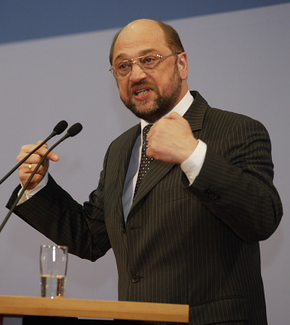
If you’re a party politician your motivations are inevitably different. The nature of party politics across all the mainstream parties and in all EU Member States means you have to play the long game, keep your views to yourself, and manage to make sure you do not offend too many people on your route to the top. You want to one day become Martin Schulz, or one of his ilk, and even if – as a younger person – you did have a burning ideology, you’re going to have to mask it in order to manage to get anywhere. Frankly it is hard to run a political party if there are too many people in it who are too intelligent, determined or opinionated, so you can get somewhere precisely because you are not any good, not a threat.
So the pickle in which party politics finds itself, especially on the left, is not in my mind a question of generations. It’s much more important and central to that. How can political parties accept risk takers, leaders, people with drive, people with ideology, and bind them into a party structure rather than making them annoyed and demoralised? For me that’s the central question, not some vague notion of generational change.



As it’s one of my favorite topics, of course I couldn’t resist writing my take on it: http://eurosocialist.blogspot.com/2009/07/political-culture-of-generation-y-aka.html
Well, as a pre-WW2 baby, I’d hardly call myself young in age: but in thinking, I hope so? The problem Socialists have to deal with is that so many national parties don’t seem to have progressed in their ideas and ideals. eg, in France, they are still stuck in a 1968 rut; in Spain and the UK they can’t seem to think beyond the “single-industry” economic approach (finance, building) that each inherited . All of this “stickiness” seems to hold equally in the EU Parliament.
I’m not sure I agree with Jon’s view that younger politicians need to “play the long game” and hold themselves back a little. Sure, the party dinosaurs have all sorts of ways of obstructing change. But how did May 68 and so many Eastern Europe anti-USSR revolutions start?
The generational question is not only an age question. It’s not only about replacing the elders by the younger ones, that would be too easy. Many young ones still think like their parents did while some elder ones are able to understand the cultural changes younger generations bring in. Look at May 68. Not all young people were culturally liberal hippies! Some were conservative. They all had the same age though. Yet if you look at history, at that moment it’s the young progressive hippies, helped by their open-minded elders who won the ideological battle. So my point is, the generational question is more a cultural question than an age question. I do believe that the future of politics lies in openess, ethics and humility. There is a growing demand for it, but still not quite a satisfactory offer (apart from Obama).
I totally agree with you, although in some ways it is a generational issue: In our generation, people like us have the technical possibilities to remain active although classical party structures are not what attracts us.
This is why some of us – still a small elite – can express their position more freely than within the compromise-driven and promotion-oriented political environment the generations before us have to live with (if they don’t learn to us creatively use the opportunities the would have).
Jon,
It is a true dilemma, because of the real constraints placed on the European Parliament, if it wants to influence any legislation.
The PES did a good job at mobilising activists when the election manifesto was produced. They failed miserably, when they did not nominate a candidate for the Commission Presidency (largely because of Zapatero, Socrates and Brown). Somehow the centre-left parties have lost credibility as the ones to handle the economy – despite the financial and economic crisis – with 22 out of 27 EU member states now in the hands of centre-right or right parties (if I remember Jean Quatremer correctly).
It seems like the socialists and social democrats need to start shaping a new set of policies, adapted to global economies, European level governance and progressive ways to combine economic growth with enhanced opportunities and improved public services for individuals, if they want to regain credibility.
Jon,
Structural, rather than generational reasons drive the political groups in the European Parliament to cooperate, as the EPP, PASD and ALDE have done.
In order to amend Commission proposals, the EP needs a vote by a majority of the component number of MEPs. No single group has such a majority.
If and when the European Union becomes a parliamentary system, with accountable government, this rule has to go, but we are not there yet.
@Julien – fair point. Perhaps it’s that the technological generation change just has not permeated politics enough yet, although at a personal level (among possible candidates) there are strong reasons for it *not* permeating.
Yes, precisely… and whatever is done in legislative terms in the EP actually does not matter that much when it comes to how things are to be presented in 2014, as – sadly – EP elections are not really about analysing a party’s (or a group of parties’) records. The left needs to develop a convincing narrative, convincing leadership, and a convincing set of policies for the future, none of which they are currently doing in Brussels as all the MEPs in the group are thinking rather more in terms of their own immediate political careers.
Yes, I’m aware of that. But there is also – even now – a presentational issue. How should the left approach things now, conscious of needing to do a lot better at the EP elections in 2014? Positioning themselves as an opposition to the right might have done the trick, but they didn’t want to go for it.